Our new Viña del Mar campus laboratory celebrates its very first publication! This study, co-led by Dr. Felipe Rojas-Thomas and Dr. L. Sebastián Contreras-Huerta in NeuroImage, validates mobile EEG as a highly dependable and accessible alternative for capturing EEG signals
For decades, studying the human brain required participants to remain completely still within highly controlled laboratory environments, often connected to bulky and expensive machinery. Although these devices offer exceptional precision, there is some doubt regarding the replicability of these responses in dynamic and real-world settings. This has long been a limitation for social-emotional neuroscience, where understanding phenomena such as empathy requires naturalistic and diverse social contexts. Can this system take a brain imaging without losing scientific rigor?
In a new st udy published in the journal NeuroImage, researchers from the ESD Lab and the Center for Social and Cognitive Neuroscience (CSCN) at Universidad Adolfo Ibáñez show that we can. Led by Dr. Felipe Rojas-Thomas and Dr. L. Sebastián Contreras-Huerta, this article marks an extraordinary milestone, it is the very first scientific publication generated from data collected at our new Neuroscience Laboratory at the Viña del Mar campus. This work not only provides a starting point for the ESD Lab, but also allows for the training of undergraduate and graduate students, from the basics of EEG to contributing to this high-impact research.
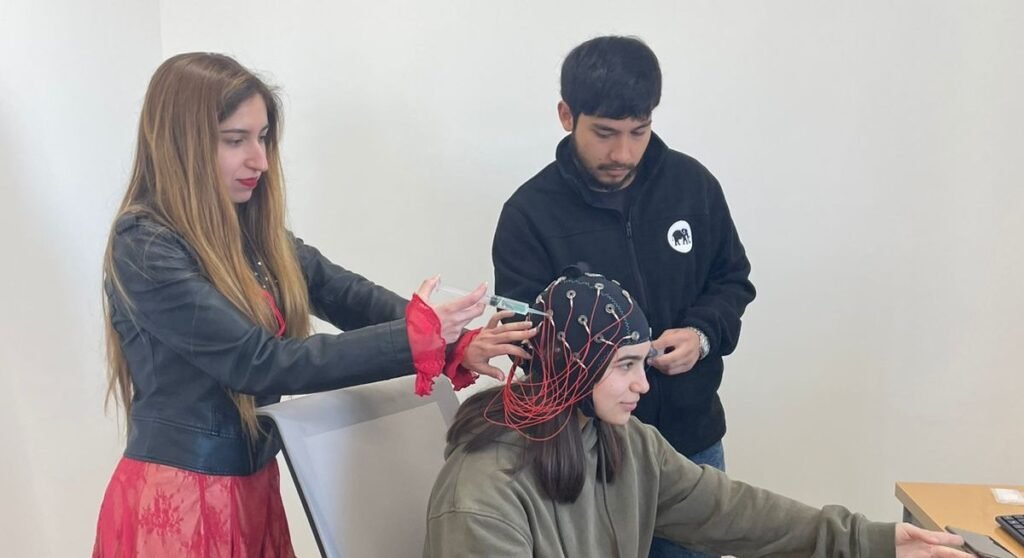
Fiorella Macchiavello, José Bórquez, and Consuelo Ruiz (ESD Lab members) actively trained under the tutelage of Dr. Felipe Rojas and Dr. Sebastián Contreras to collect, process, and analyze the EEG data. These hands-on learning environments enable students to develop fundamental skills for the academic world, supported by experienced faculty.
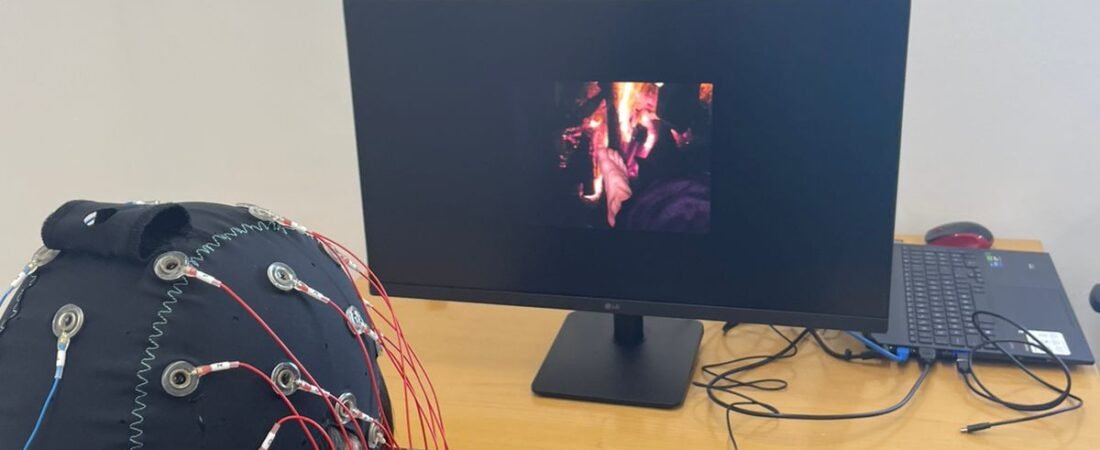
To test the validity of lightweight, mobile EEG systems, the research team applied an empathy-for-pain paradigm, where participants were exposed to images of pain and no-pain. They recorded participants’ neural activity using both mobile EEG devices and traditional, high-resolution laboratory EEG equipment under identical conditions. The goal was to see if the mobile equipment could capture brain responses equivalent to traditional laboratory equipment associated with feeling others’ pain.
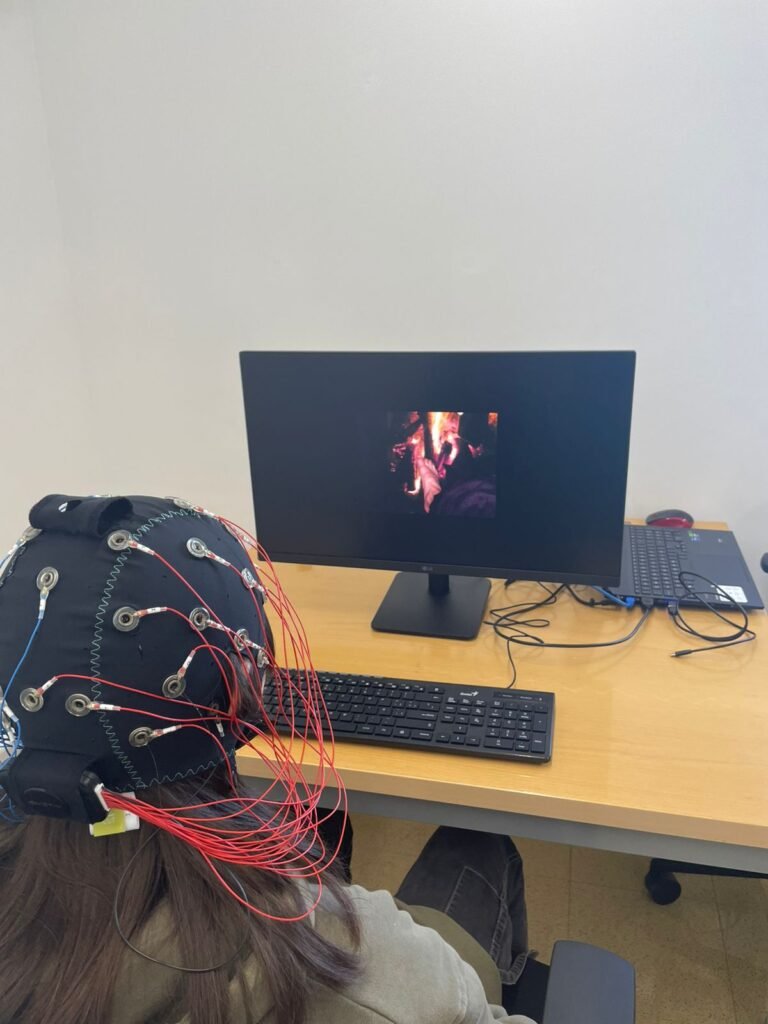
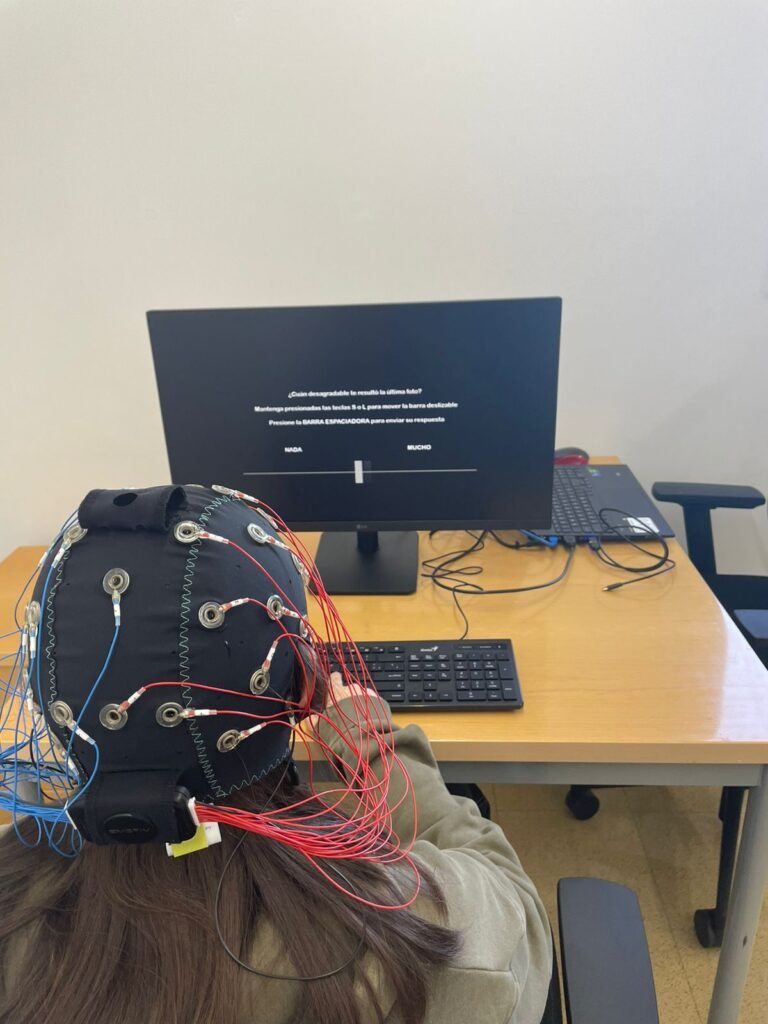
The results were highly encouraging. The study demonstrated that mobile EEG successfully and reliably captures late event-related potentials (ERPs), which are important neural components for advanced cognitive and emotional processing. While high-resolution laboratory systems continue to be advantageous for more specific analyses, mobile EEG proved to be a valid alternative for measuring key socioemotional responses.
These findings provide great methodological value in the validation and use of mobile EEG devices in the measurement of neural responses. This study opens the door to studying human interaction in more inclusive, diverse, and ecological environments. For our school and our lab, this milestone not only validates a new technology but also cements the Viña del Mar Neuroscience Lab as a thriving center for cutting-edge research and student formation.
References:
Rojas-Thomas, F., Macchiavello, F., Soto, V., Rivera-Rei, Á., Franco-OByrne, D., Bórquez, J., Ruiz, C., Ramírez-Barrantes, R., Huepe, D., & Contreras-Huerta, L. S. (2026). Mobile EEG as a valid alternative to high-resolution laboratory EEG measures. NeuroImage, 333, 121950. https://doi.org/10.1016/j.neuroimage.2026.121950
