The UAI Master’s student presented research on accessible EEG and the cognitive mechanisms associated with empathic choice across socioeconomic contexts.
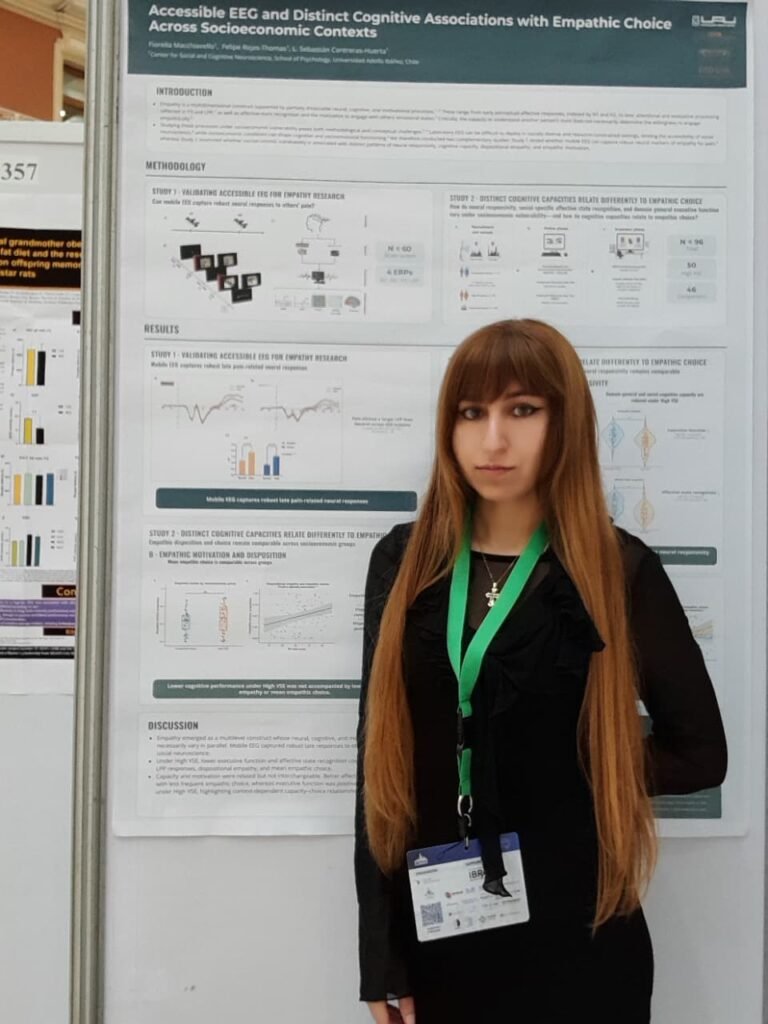
At the beginning of September, Fiorella Macchiavello, Master’s student in Clinical Psychology at Universidad Adolfo Ibáñez, participated in the IV FALAN Congress, held in Santiago, Chile, where she presented the work “Accessible EEG and Distinct Cognitive Associations with Empathic Choice Across Socioeconomic Contexts.”
Fiorella conducts her research under the supervision of Luis-Sebastián Contreras-Huerta, Principal Investigator at the Emotion and Social Decisions Lab (ESDLab) and researcher at the Center for Social and Cognitive Neuroscience (CSCN).
Her presentation addressed a central challenge for contemporary social neuroscience: how can we build a more inclusive neuroscience of empathy while maintaining methodological and conceptual precision?
To approach this question, the presentation brought together two complementary studies examining inclusivity in empathy research from different perspectives: the accessibility of neurophysiological methods and the importance of distinguishing between the different processes involved in empathic behavior.
Making the neuroscience of empathy more accessible
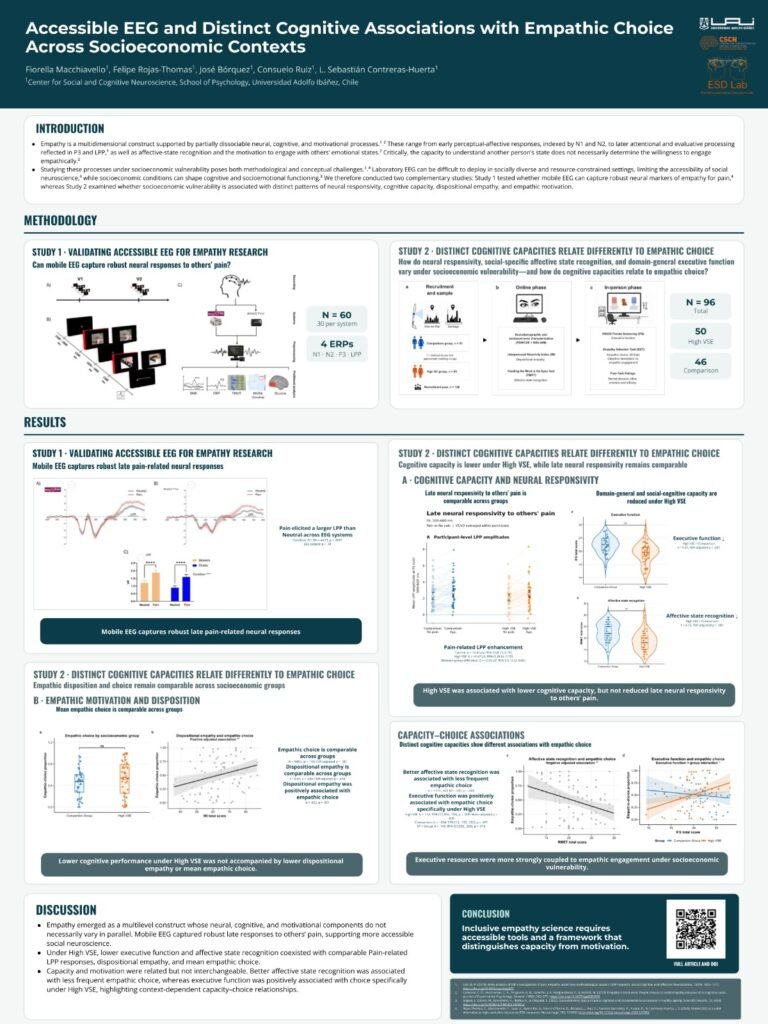
The first study presented at FALAN was the recently published article “Mobile EEG as a valid alternative to high-resolution laboratory EEG measures” (Rojas-Thomas et al., 2026), published in NeuroImage.
The research compared a high-density laboratory EEG system with a more accessible mobile EEG system to determine whether both could detect neurophysiological responses while participants observed other people’s pain.
Despite differences in signal quality and technical characteristics, both systems reliably captured modulation of the Late Positive Potential (LPP) in response to painful compared with neutral stimuli. These findings suggest that mobile EEG can serve as a complementary tool for investigating robust neurophysiological phenomena in settings where conventional laboratory infrastructure may be difficult to implement.
Importantly, this approach is not intended to replace high-resolution laboratory EEG. Instead, it may help reduce methodological barriers and extend neuroscience research to populations and contexts that have historically been underrepresented.
Empathy across socioeconomic contexts
The second study originated from Fiorella’s undergraduate thesis, developed under the supervision of Luis-Sebastián Contreras-Huerta and subsequently transformed into a scientific manuscript. The work is currently available as a PsyArXiv preprint under the title “Executive Function and Affective State Recognition Show Distinct Associations with Empathic Choice Across Socioeconomic Contexts.”
The study examined 96 Chilean adults from different socioeconomic contexts to investigate whether different dimensions related to empathy show similar patterns across groups and how specific cognitive abilities relate to the decision to engage empathically with others.
The findings revealed an important distinction. Although participants experiencing high socioeconomic vulnerability showed lower performance in executive function and affective-state recognition, these differences were not accompanied by detectable reductions in empathic disposition, average empathic choice, or late neural responses to others’ pain.
Moreover, cognitive abilities showed distinct relationships with empathic behavior. Affective-state recognition and executive function were not uniformly associated with greater empathic engagement, and the relationship between executive function and empathic choice differed according to socioeconomic context.
Together, these results reinforce an important conceptual point: the capacity to understand or process another person’s emotional state and the motivation to engage empathically with that person are related, but they are not interchangeable.
Towards a more inclusive neuroscience of empathy
By bringing these two studies together, Fiorella’s presentation highlighted two complementary dimensions of scientific inclusion.
On the methodological side, more accessible neurophysiological technologies could help expand where and with whom neuroscience research can be conducted. On the conceptual side, studying diverse populations also requires greater precision when interpreting measures of neural responsiveness, cognitive capacity, empathic disposition, and motivation.
Together, these perspectives contribute to an ongoing line of research at ESDLab aimed at understanding empathy and social decision-making while considering the contexts in which these processes take place.
We congratulate Fiorella Macchiavello on presenting this work at the IV FALAN Congress and on her continued development as an early-career researcher at the intersection of social neuroscience, empathy, and socioeconomic context.
Learn more
The following scientific resources are available in English:
Rojas-Thomas et al. (2026). Mobile EEG as a valid alternative to high-resolution laboratory EEG measures. NeuroImage, 333, 121950.
Macchiavello et al. Executive Function and Affective State Recognition Show Distinct Associations with Empathic Choice Across Socioeconomic Contexts.
